Great massacre
The Crying of Lot 49The Holocaust is recalled in the novel through Dr. Hilarius’s testimony about his role in experiments at Buchenwald, then returns as a moral reference point in Oedipa’s reflections on injustice and historical meaning. These episodes do not settle the novel’s central uncertainties; instead, they show how memories of atrocity pass through compromised witnesses, political institutions, and commercial culture, acquiring significance without becoming a stable explanation of the present.
Hilarius’s account of Buchenwald
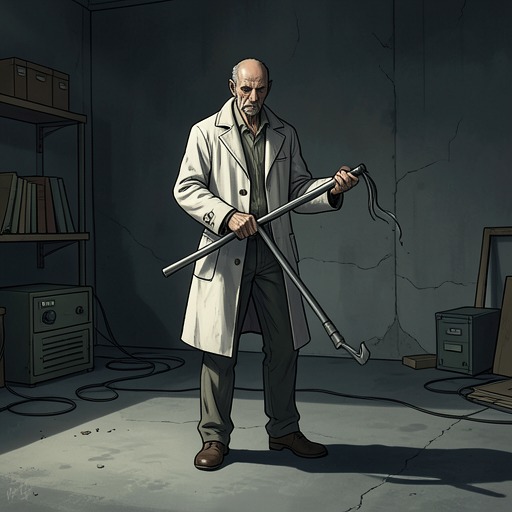
When Oedipa asks what he did at Buchenwald, Dr. Hilarius says that he worked on experiments intended to induce insanity. He describes a program that subjected prisoners to an array of methods, including metronomes, staged scenes, surgery, drugs, concealed threats, hypnosis, backward-running clocks, and experiments with faces, for which he was responsible. He says that Allied forces arrived before the researchers had gathered enough data, though he identifies a prisoner named Zvi as a striking success.
Hilarius presents his later medical practice as an effort to atone, but the account makes the limits of that claim unmistakable. He says he chose Freud rather than Jung because Freud’s vision offered a world without camps, a fantasy in which Buchenwald could become a soccer field and the killing facilities at Auschwitz could be repurposed. He describes trying to believe in that transformation and devoting himself to that belief, yet concludes that his penance has not been enough. His account places attempted moral repair beside the unassimilated history of the crimes, without suggesting that one can cancel the other.
Memory, belief, and historical evidence
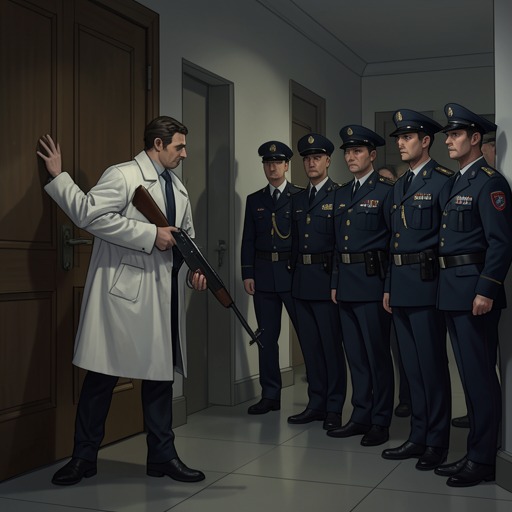
Hilarius’s testimony is delivered during a crisis in which he believes people have come to take him back to Israel for trial. His fear makes his account inseparable from his present breakdown, but the narrative gives its historical details directly through his speech. Oedipa’s response is not a verdict on his claimed atonement: she takes up the rifle he has left behind and tells him she ought to kill him, while recognizing that he wanted her to take it. The scene refuses an easy distinction between confession, remorse, and manipulation.
Elsewhere, historical knowledge in the novel reaches Oedipa through fragmentary and uncertain channels: elderly recollection, a historical marker, old publications, and objects bearing the post horn. Her meeting with Mr. Thoth connects a family story about the Pony Express to a signet ring marked with the W.A.S.T.E. symbol; Mike Fallopian warns that an accidental correlation may be impossible to trace back to a reliable source. That larger pattern of unstable transmission frames the Holocaust account differently: Hilarius offers a personal confession, but the novel does not turn his testimony into a general key that resolves its other histories.
The Holocaust as a measure of American complicity
The Holocaust returns explicitly in Oedipa’s encounter with Winthrop Tremaine, who describes selling Nazi armbands and planning to market SS uniforms through a clothing company’s back-to-school campaign. Oedipa leaves without confronting him, then reproaches herself for allowing the business to continue. Her reaction makes the historical reference immediate: atrocity is not only something recalled from Europe but also a standard against which present-day indifference and profit can be judged.
Near the novel’s end, the question of Tremaine’s commercial reprieve appears among the alternatives Oedipa weighs: it may represent an injustice, or simply an absence of larger meaning. The Holocaust therefore enters the novel neither as a resolved historical lesson nor as an emblem that explains everything. It stands as a moral fact against which competing interpretations of American life, the legacy Oedipa administers, and the possible reality of Tristero remain painfully unsettled.
Narrative significance
The Holocaust scenes place personal testimony and public memory in a novel preoccupied with uncertain records. Hilarius’s detailed recollection coexists with his unstable present, while the Nazi-themed merchandise Oedipa encounters converts historical reference into commerce. The contrast is consequential: attempted atonement may be sincere without repairing the past, and the continued presence of atrocity in cultural memory does not guarantee that the present will respond to it.
This historical reference also intensifies the novel’s recurring pressure to choose between explanations. Oedipa can regard Tremaine’s reprieve as an injustice that demands a meaningful account, or as another event without a governing design. The Holocaust does not solve that dilemma; it gives its moral stakes a concrete historical weight, making uncertainty about the world harder to confuse with indifference to what people have done.